The Problem
Your Tesla Hood Is More Vulnerable Than You Think
Tesla's frunk lid is aluminum — and aluminum doesn't behave like steel. It has no elastic memory. When a cargo point load concentrates pressure against the underside of the hood, the metal deforms permanently. Tesla service advisors have reported seeing this in roughly 1 in 5 Model Y vehicles. The owner's manual even warns about proper two-hand closure technique for this reason.
The crease is usually invisible until you open the frunk and look at the underside — and by then, it's already there.
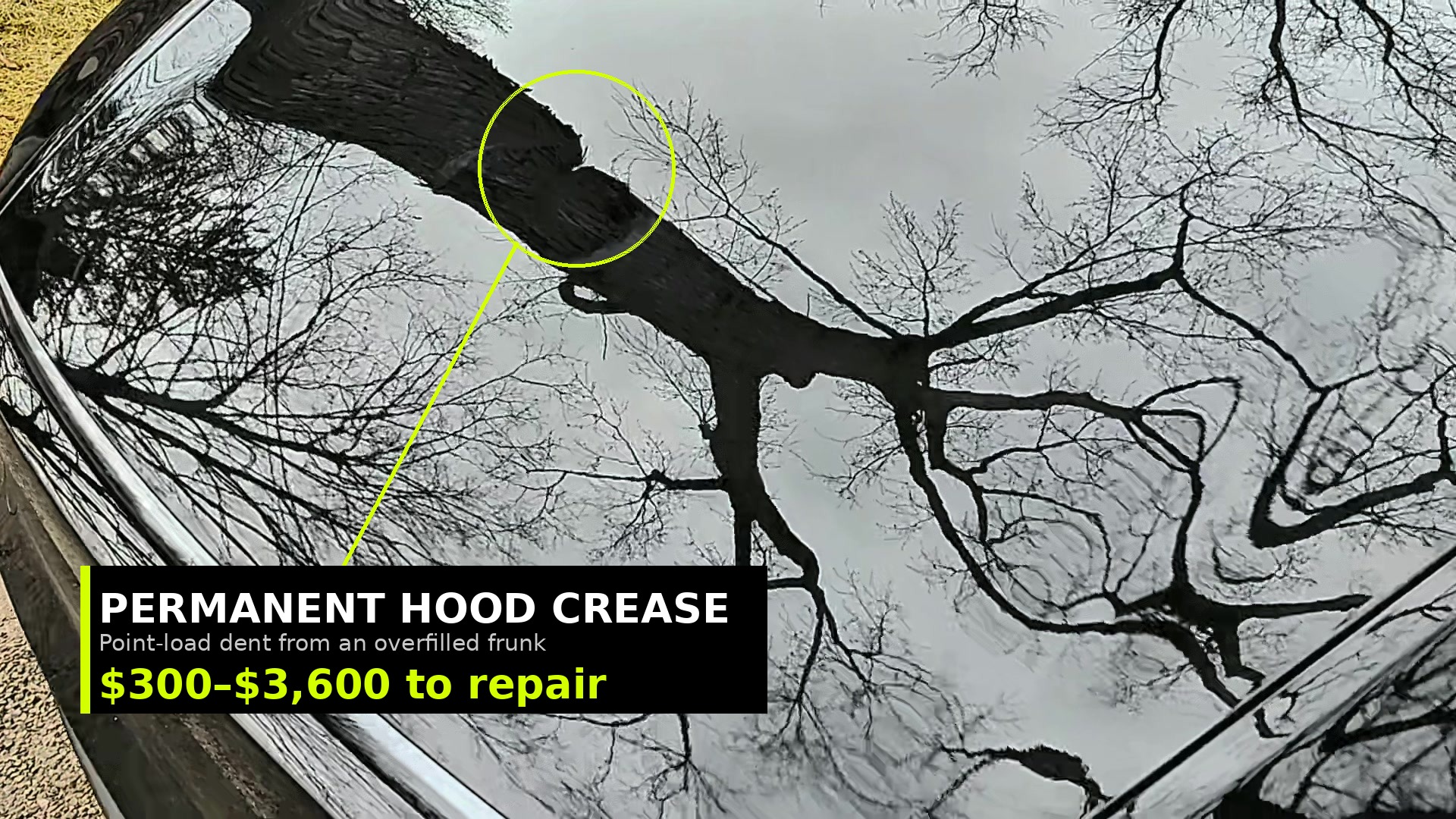
The critical detail most owners don't know: even the best PDR technicians will tell you upfront that a crease on aluminum may only improve 80–90%. The metal has been stretched past its elastic limit. A remaining flat spot is often permanent — and you still pay full price for that outcome.
Why Forum Quotes Mislead
A Frunk Crease Isn't a Door Ding.
Search online and you'll find PDR quotes in the $250–$500 range. Those numbers are real — but they're for a fundamentally different repair. Every PDR specialist sorts dents into categories, and a frunk crease from cargo load is not the easy one.
A frunk crease hits Tier 3 because aluminum carries a 40–50% labor premium over steel and the metal is stretched past the elastic limit it relies on to recover. Tier 1 and Tier 2 quotes don't apply — phone quotes often default to Tier 1 pricing until the technician actually sees the damage.
"Most shops quote low to win the job. When the damage is actually a crease on stretched aluminum, the honest number is three to four times higher — and a lot of technicians are afraid to say that upfront."
— PDR specialist, Dent Time (San Diego)The Cost Stack
Three Scenarios. None of Them Cheap.
You pay for a PDR attempt — $600–$900. It improves the crease but leaves a visible flat spot. Now you need conventional body repair or full replacement on top of what you already spent.
Combined total: $2,250–$3,600. This is the scenario that surprises owners who assumed PDR was a safe first step.
The Math
FrunkVault as a Percentage of What It Prevents
FrunkVault Core is $169. Here's what that looks like against each damage scenario:
| Damage Scenario | Avoided Cost | FrunkVault as % of Avoided Cost |
|---|---|---|
| Best-case PDR (partial improvement) | $300 | 56% |
| Typical PDR on aluminum crease | $750 | 23% |
| Full replacement, standard color | $1,750 | 10% |
| Full replacement, premium color | $2,700 | 6% |
| Failed PDR + full replacement | $3,200 | 5% |
Across every realistic outcome, FrunkVault costs 5–23% of the loss it prevents — a compelling proposition by any measure. And even in the single best case, a flawless $300 PDR, the comparison still favors prevention: FrunkVault is a one-time purchase that stops the damage from ever happening, while PDR is a repair attempt carrying no guarantee on stretched aluminum. That best case is also the exception — if the metal has stretched too far or the first attempt disappoints, costs escalate fast toward full replacement. Prevention is the only path that never leaves a permanent scar in your hood.
The Takeaway
Prevention Is the Only Option That Works Every Time
PDR on aluminum is skilled work — and the best technicians are honest about its limits. Full replacement is effective but expensive and requires color matching that is never guaranteed to be invisible. Both options assume the damage has already happened.
FrunkVault is the only option that eliminates the outcome entirely. It installs to the underside of the hood in about 60 seconds, requires no vehicle modification, and distributes cargo load across the frunk's structural skeleton rather than concentrating it on the hood panel. Once it's in, the scenario above simply doesn't happen.
The math isn't complicated. $169 to prevent a $300–$3,600 repair is not a close decision.
PROTECT YOUR HOOD.
FrunkVault Core is $169 and Signature is $189. Founding Batch shipping is included. Now shipping in limited quantities.
ORDER YOUR FrunkVaultFounding Batch shipping included · 30-day returns · Patent pending